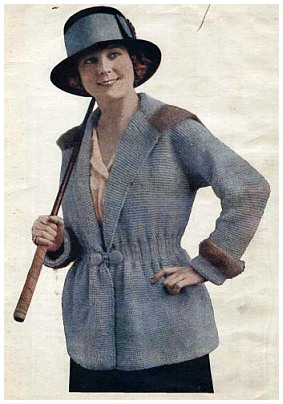
 Maybe it’s just me, but it seems way too many people are building websites based around “vintage” or public domain patterns without regard to copyrights and other niceties.
Too many crafters are simply assuming that the original copyright holder did not renew their copyright. Patterns published in the 1940s and 50s are not necessarily out of copyright. It all depends upon whether or not the original copyright holder filed for an extension.
Posting a disclaimer like, “As far as I know this pattern is out of copyright but if you know differently please let me know.” at least shows the website owner has considered the pattern may still be protected. Problem is that disclaimer offers zip, zero, nada protection for the site owner or anyone else who might wish to sell items made from that pattern. Having a disclaimer is not a free pass for copyright infringement. Site owners can still be forced to remove the infringing content or even be sued by the true copyright holder.
A recent submitter to Crafty Tips seems to have employed a hybrid approach where they are placing usage restrictions on each public domain pattern or pattern with a questionable copyright status. Normally, I would have happily added their site as it does have a nice selection of different, mostly public domain patterns. The whole ‘maybe it’s still in copyright issue’ didn’t bug me as much as the strange attempt to restrict usage. Some of the vintage and public domain patterns are identified as “free for personal use” while others are identified as being free for both personal and commercial use.
Granted, had the site owner used her own picture or made a number of rewrites to a pattern truly in the public domain, they could claim some level of copyright on the work. The pictures look like they were originally published with the pattern and there is no indication that the site owner made any changes to the original pattern.
When I post vintage and public domain craft patterns on The Crafty Tipster like the vintage sweater shown in this article, I always give credit to the original designer (if known) and the original publication information. Technically, if a vintage pattern is truly in the public domain, such attribution is not required. I do it to both honor and respect the original designer as well as to ensure that anyone outside of the US has the information needed to ensure that the pattern is also in the public domain in their own country or any country they may sell the finished item in.
Only if I include a picture of an item I made or if I have made a number of changes to the pattern itself, am I creating something new that I can copyright – even then I provide the original designer’s info. The collection of patterns as a whole can be copyrighted but an individual public domain pattern that has not been changed remains in the public domain.
The vintage pattern site, for now, is lingering in my submission queue. Part of me wonders if I am simply being too picky. The pattern designer in me doesn’t like the attempt at adding usage restrictions to something the site owner does not own. Granted, the legality of usage restrictions on patterns is a bit muddled but I see it as disrespecting both the original designer and the spirit of copyright law.
What are your thoughts? Do you care if someone posts a vintage, public domain pattern and claims some level of ownership? Do you think the original designer should always be credited regardless of copyright status?
Usage restrictions on direct reproductions of vintage items (no changes made) really bug me. It is basically taking someone else’s art work for profit and then saying no one else can take it and profit from it. What gives them the right to do this? It is very shady.
One the other hand, I do often think about the legal and moral issues involved when you take elements from vintage designs for use in new designs. I love vintage stuff and often use old patterns for inspiration. How much do you need to change something to be o.k. legally and morally? I do like the idea of old forgotten patterns getting new life by being reprinted…sort of the creative spirit of the original artist living on in newish artwork. But even in this case I’m not a big fan of usage restrictions.
You bring up a number of issues.
I too love the idea that these wonderful old patterns are being dug out of attics, libraries and all sorts of hidden places. To some extent I don’t even mind people are trying to figure out a way to make a bit of a profit from them – after all, that is something I’m doing myself.
But, I think folks are crossing the line, at least morally, when they republish a vintage pattern and claim ownership without having added anything. My understanding, which could be incorrect, is that copyright law does not include usage restrictions or licensing of patterns. Which means this whole, “may not be used for commercial purposes” is not something a designer can actually prohibit – again presuming my reading of the law is correct and things haven’t changed.
What percentage of change is required to make a pattern “new” is often debated and there seems to be no “true” or “legally defined” number, I employ the strategy of giving both parties credit. I do however, take credit for the revised pattern (if I’ve made more than just a few corrections) and any pictures of items I have made from it.
I see a lot of online shops, websites and craft fair booths; no matter how clever and creative the pieces might be, if you look around long enough and hard enough there’s almost always something similar made earlier.
A fellow I spoke to at the American copyright office explained to me that the spirit of copyright law was to never protect a work in perpetuity. The hope was to let the creator enjoy the fruits of their labor during their lifetime and then when they were gone the copyright would expire allowing others to build upon the work to make it better.
Most people are just too lazy to conduct copyright research. Or they aren’t actually aware of the whole public domain genre.
I’m not sure it’s a matter of laziness as a matter of not understanding the laws or simply thinking that they would never get caught. My favorites are the folks, who when caught, defend themselves by saying “How could I possibly know that something was copyrighted or not, I put a disclaimer up saying if anyone objected that I would take it down.” Oh, yes, you didn’t know when you copy and pasted an entire article from another website that the original site owner might object to you stealing their work and calling it your own.
Thanks for visiting and leaving a comment!
I certainly agree with you, even when a pattern is copywrited and or in public domain credit should always go to the creator. Its a mark of respect of what they have contributed, we credit Picasso, Debussey and Monet why not our more modern artists and designers
Regards
Margaret
There are a number of people selling downloadable patterns on eBay and ETSY. Not just individual patterns but scans of the entire book/booklets. I thought if not illegal it is certainly unethical so I contacted Coats and Clark about this and they replied firmly that they retain their publications’ copyright and any reprinting without permission is illegal. I have also brought this up in an ETSY forum and the apathy regarding this issue was pathetic. I suggested that, since ETSY is benefiting from the illegal distribution of copyrighted materials that they should police this a bit. It is not their policy. Any copyright holder who feels they have been violated must take the enormous task of defending their intellectual property. It is the law that is the problem here. In an era of instant downloads it will be increasingly difficult to protect not only intellectual property from the 50’s but current material. The enforcement differs from country to country too. If it were not for the fact that a lot of time and money goes into the development of these products it would not seem such a bad idea. But if the law protected these patterns like they protect pharmaceutical formulas we’d all see a much more level playing field.
Thanks for this post.
You are so right about the law being the problem. Having a giant window where copyright holders were required to refile their copyright or lose it has just made it virtually impossible to know what things published in the 1940s and 1950s are still protected. What a horrendous idea that was.
I am disappointed that Etsy appears to not give this issue the attention it deserves. I’ve seen a few folks offering electronic versions that can be sent immediately while the original makes it’s way through the postal system and think that’s a great idea. But, I’m not a fan of the folks who photocopy protected works and sell them as if they are the actual copyright holder.
As far as downloadable patterns on eBay, that has been a big problem for years. Sadly, folks there have sold “their” patterns which were ones they had found online or purchased on Etsy. The Internet has so terribly blurred the lines for copyright and ownership. I’ve lost count at how many hours I’ve spent having to chase down folks who have stolen my content and claimed it as their own. The vast majority know they are doing something wrong but take the attitude of if the owner catches me, I’ll just take it off my site. I’ve had a number of conversations with the US Copyright Office and they will be the first to tell you that copyright law has simply not kept up with the giant information distribution network known as the Internet.
Other than making the penalties more severe and providing greater relief for those who’s work is stolen, sadly I don’t see anything really changing. It’s just to darn easy to copy and paste something and throw it up online. With big pharma, someone has to at least reverse engineer the formula before they can sell ‘their version’.
Thanks for the feedback and I look forward to hearing from you again.