Tag-Archive for » legal issues «

Jan
26
Posted by Michele on January 26, 2010

Maybe it’s just me, but it seems way too many people are building websites based around “vintage” patterns without regard to copyrights and other niceties.

Too many crafters are simply assuming that the original copyright holder did not renew their copyright. Patterns published in the 1940s and 50s are not necessarily out of copyright. It all depends upon whether or not the original copyright holder filed for an extension.

Posting a disclaimer like, “As far as I know this pattern is out of copyright but if you know differently please let me know.” at least shows the website owner has considered the pattern may still be protected. Problem is that disclaimer offers zip, zero, nada protection for the site owner or anyone else who might wish to sell items made from that pattern. Having a disclaimer is not a free pass for copyright infringement. Site owners can still be forced to remove the infringing content or even be sued by the true copyright holder.

A recent submitter to Crafty Tips seems to have employed a hybrid approach where they are placing usage restrictions on patterns that are either fully in the public domain or might have been renewed. Normally I would have happily added their site as it does have a nice selection of different patterns. The whole maybe it’s still in copyright issue didn’t bug me as much as the strange attempt to restrict usage. Some of the vintage patterns are identified as “free for personal use” while others are identified as being free for both personal and commercial use.

Granted, had the site owner used her own picture or made a number of rewrites to a pattern truly in the public domain, they could claim some level of copyright on the work. The pictures look like they were originally published with the pattern and there is no indication that the site owner made any changes to the original pattern.

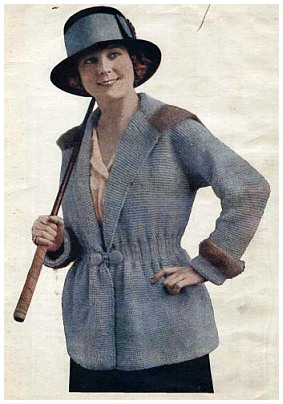
When I post vintage patterns on The Crafty Tipster like the vintage sweater shown in this article, I always give credit to the original designer (if known) and the original publication information. Technically, if a vintage pattern is truly in the public domain, such attribution is not required. I do it to both honor the original designer as well as to ensure that anyone outside of the US has the information needed to ensure that the pattern is also in the public domain in their own country or any country they may sell the finished item in.

Only if I include a picture of an item I made or if I have made a number of changes to the pattern itself, am I creating something new that I can copyright – even then I provide the original designer’s info. The collection of patterns as a whole can be copyrighted but an individual pattern that has not been changed remains in the public domain.

The vintage pattern site, for now, is lingering in my submission queue. Part of me wonders if I am simply being too picky. The pattern designer in me doesn’t like the attempt at adding usage restrictions to something the site owner does not own.

What are your thoughts? Do you care if someone posts a public domain, vintage pattern and claims some level of ownership? Do you think the original designer should always be credited regardless of copyright status?

Jan
12
Posted by Michele on January 12, 2010

I can make that! I wrote that! My daughter wrote that, ain’t she smart?

It seems like an endless battle to fight the scammers, thieves and other no-good-knicks that STEAL from others.

Just when I thought I had gotten the content theft occurring on my Foods Not Safe for Pets article under control, I found yet another cretin posting the article in it’s entirety on Yahoo! Answers. And for good measure, she claimed her daughter who was attending veterinarian school provided the list – ah nice, a liar and a thief.

According to one of my new Twitter friends, in a recent Etsy feature on weddings, one of the “artisans” featured populated her shop with stolen photographs and created listings using them stating that they could make a copy of the designer dress in the image for some fee. Under mounting pressure from the Tweets, comments and other discussions; Etsy has apparently closed the offending shop.

Well, that’s one for the good guys. Now I’m off to see about yet another DMCA notice and updating that page to make it clear that people should stop posting my entire article on Yahoo!

Dec
08
Posted by Michele on December 8, 2009

I guess it was bound to happen sooner or later. Spend enough time and effort on something that you publish online and sooner or later someone, somewhere is going to help themselves to your hard work.

Granted, many bloggers do not understand that taking something they found online and posting it on their own site or blog is theft. But, as the saying goes, ignorance of the law is no excuse. Linking back to the original author’s site or including a single reference within the article does not constitute fair use.

In my research today on the Digital Millennium Copyright Act, I found a blogger who wrote an indignant post about a DMCA notice sent to them by the New York Times. A huge number of the 120+ replies seemed to think that since the blogger was giving credit, posting links and sending traffic to the original pieces that should have somehow eliminated the Times’ copyrights or that the Times was simply being a big, bad, money grubbing meany for protecting their own property.

I wasn’t actually looking to see if someone used my work without permission. My to-do list is so long right now and sending DMCA notices is not part of my idea of Christmas tidings.

Someone emailed me about an article appearing on one of my websites. They were asking where my information had come from and for some further clarification. The article in question is called Foods Not Safe For Pets. In the process of revisiting the original source material, I realized that I had made a typographical error in the name of something by inadvertently leaving out a letter.

What I also discovered was that my original article had been copied, sometimes word-for-word and other times in pieces on a variety of other blogs, websites and forums. I have never received a single request for reprint permission and while I am glad the information is being seen by more pet owners, it’s so not cool that a number of folks failed to at least identify where the information came from. Giving credit would not have constituted permission but it would have at least provided an accurate attribution and recognition for the hours of research that went into the piece.

There is a bit of irony in all of this that everyone who infringed upon my copyrights by using my article without permission left a very tell-tale signature in the piece due to the error I discovered over the weekend. That one typo suddenly became a smoking gun leading to a number of folks who I now find myself sending DMCA notices to.

Personally, I hate the idea of sending some legalese-type notice to folks who may have honestly not realized what they were doing was unlawful. Trouble is, it’s hard to tell folks who knew they were stealing from those who simply didn’t understand copyright law.

It’s unfortunate that rather than being able to send a less confrontational and more personal request about removing my work, I had to send this official and threatening letter. Don’t get me wrong, I am not a happy camper that so many folks felt it was OK to essentially steal from me and I’m glad you couldn’t hear the not-so-nice words I shouted when I discovered the theft. But, I do realize that not everyone understands that “borrowing” someone else’s written words is indeed copyright infringement and something that I could ultimately sue them over. At the same time, sending a softer letter might have a negative impact on my rights as the true owner.

A number of folks have apparently used my article as source material for their own. There’s nothing wrong with taking known facts and creating a new work – after all, that’s what I did in creating my article. Where it becomes problematic is when the new work utilizes words, phrases and passages lifted directly from the original. Using my original phrasing classifies the “new piece” as a derivative work and not an original composition. The typo has been incorporated in several new works as well as some copyright infringing derivative works.

One of the people went so far as to even use one of the images that is part of my website’s overall design and which appears on several pages. The most disappointing case is where one site owner actually gives credit to another company for compiling the piece; which of course is not true. I was angry and disappointed to see that false attribution but a part of me wondered if the site owner who posted my content knew the material was stolen. Researching the contact info for that site owner led me to discover that not only does she do online writing but that she teaches others. One can only hope that she believes in the “do as I say, not as I do” concept.

So far I have received one reply and the site owner has removed my work. Needless to say she was not a happy camper either and was somewhat nasty in her reply. In my response back to her I suggested that she consider how she would feel if she discovered someone had copied from her lovely site without permission. I’ve heard back from her and now we hopefully have an understanding and no hard feelings.

Anyway, I posted this to vent a little bit. It sucks when you’re ripped off. But, I’m also hoping that some blogger or other site owner might see this and learn that it is not OK to post someone else’s work without permission even if they provide a link to the original source.

If you have posted someone else’s work without written permission, please remove it now. It’s painful to find out that someone, or in my case a number of someones, has stolen your work. It’s absolutely no fun to send nasty emails to strangers. And it’s not a nice prospect to consider the need to hire an attorney to protect your property.

Jan
10
Posted by Michele on January 10, 2009

From the “this possibly can’t be true files”, it appears that in about a month anyone buying, selling or manufacturing products designed for small children is going to find themselves in a morass of new legal requirements that the spokeswoman for the Consumer Product Safety Commission called a “sticky and tricky” new law.

One could suppose that the law has good intentions – preventing children from being exposed to dangerous toys, clothing and just about anything else that contains excessive amounts of lead and a number of other toxins. With the seemingly endless recalls of food and other products with excessive amounts of lead and melamine, it did seem like there needed to be action taken.

So, like they always do, our government in their typical fashion toward gobbleydygook-filled regulations that even lawyers need lawyers to interpret, opted to create a new and industry-unfriendly law that goes to the extreme rather than simply enforce the laws we already have.

more…

Nov
08
Posted by Michele on November 8, 2008

Ever had a bad experience with a company? unhappy faceI know I have. And I wanted to tell the whole world just how bad my experience was. In the past, I would tell my friends and family about the company and suggest they find another company to deal with. When I had my last apartment I had a list in my address book of companies that had cheated friends and co-workers and a list of companies that came highly recommended by those same friends and co-workers.

With blogs, anyone can instantly tell hundreds, thousands, even tens of thousands of strangers about their unhappy experience. That single blog entry has the potential to lead to lost revenue for the company being discussed and hurt that company where it matters most. If you think about it, isn’t that really the intent of telling others that a company should be avoided?

A clever marketing or business owner might find that blog entry, work with the blogger to resolve the issues and turn an unhappy customer into one of their happiest. That blog entry suddenly becomes a real-life example of how well the company deals with problems and how they fix them.

Or, the company being discussed could simply hire a lawyer and file a lawsuit looking for reimbursement for lost revenues and even ask for punitive damages. The blogger might feel they are simply relating a factual accounting of their experience and stating an opinion. Free speech and all that. Right? Maybe not.

more…